
Journal · Industry data
Three droughts in five years
England has just had its driest July in 190 years, and 71.3% of the country is in drought — the third in five years. Cheshire is the exception, for now. What the water numbers mean for anyone specifying a bathroom this year.
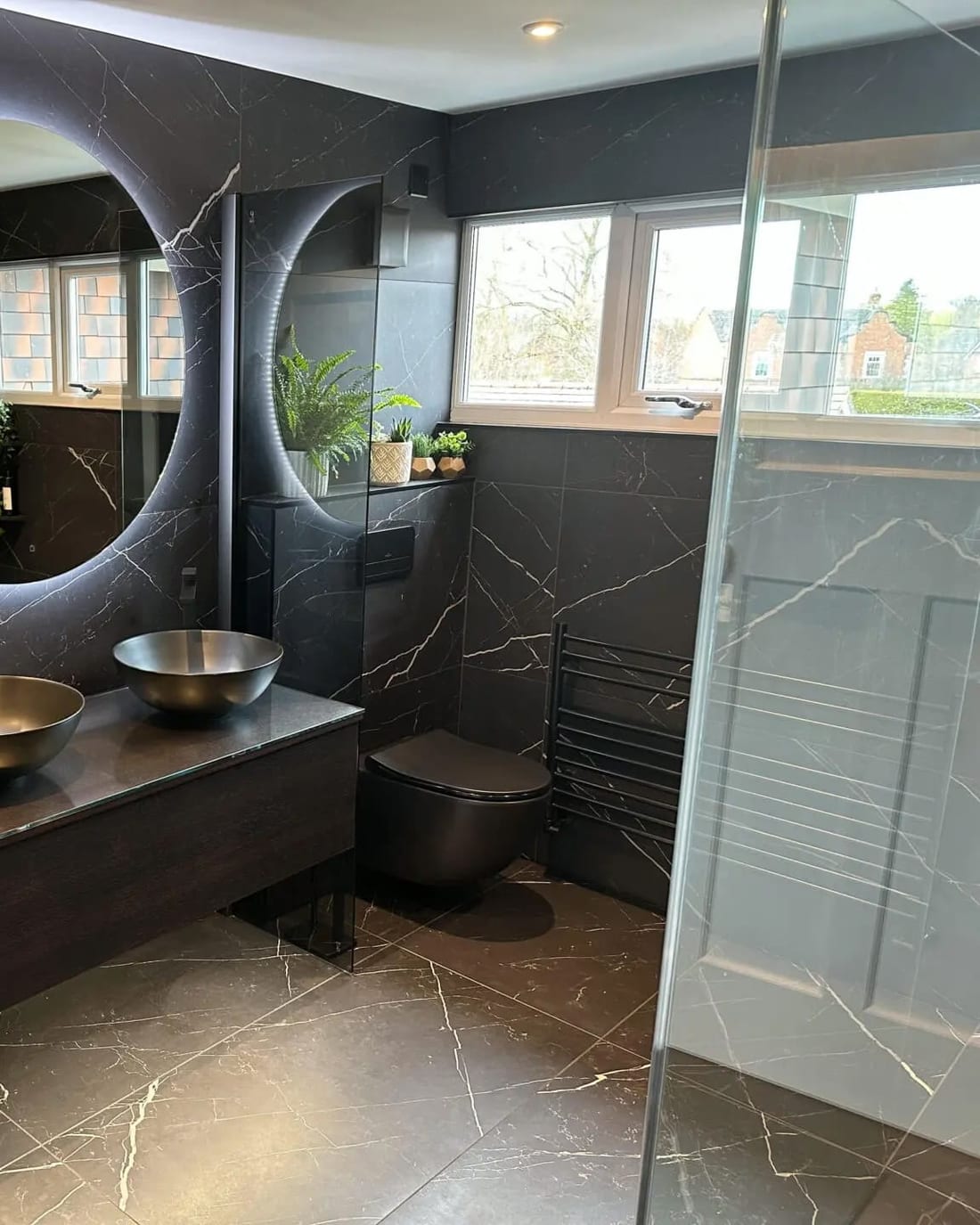
England has just recorded its driest July in 190 years. On 10 August the National Drought Group confirmed that 71.3% of the country is in drought, 45 million people live in a drought area, and more than 27 million are under restrictions on how they use water. It is the third drought in five years — 2022, 2025, now 2026 — and it has quietly changed what a bathroom specification is. Flow rates, flush volumes and fittings that don’t leak used to be the virtuous column in the brochure. They are now the practical one.
This is not a piece about Cheshire running dry. It isn’t — and the honest local picture is below. It is about the direction of travel for anyone specifying a bathroom they intend to live with for fifteen years.
The headline numbers
of England in drought as of 10 August
people under restrictions on water use
droughts in five years — 2022, 2025, 2026
extra litres a day England must find by 2055
Cheshire is the exception — read that carefully
Cheshire sits in the Environment Agency’s Greater Manchester, Merseyside and Cheshire area, which is in prolonged dry weather — the stage before drought, not drought itself. United Utilities is not among the eight water companies running hosepipe bans, and the Agency’s weekly report has it at enhanced monitoring, the lowest rung of drought response. The north-west was also the least dry corner of England in July, receiving 26% of its normal rainfall where the south-east got 1%.
But nowhere in England is now classed as normal. National reservoir storage stood at 65.9% on 11 August, 13.8 percentage points below the seasonal average, after falling faster in July than in any July for at least thirty years. And the same weekly report names Cheshire — for the first time — among the areas where voluntary abstraction restrictions may be needed if the dry weather continues. Those would fall on farm licences, not household taps. Still: the stage before drought is not the same as no drought at all.
A year of rain, month by month
England rainfall in 2026 as a share of the 1991–2020 long-term average
| January | 150% | |
|---|---|---|
| February | 170% | |
| March | 83% | |
| April | 38% | |
| May | 74% | |
| June | 104% | |
| July | 10% | |
| August | 5% |
August is to 10 August only. A wet winter is why reservoirs began the summer full; four dry months are why they didn’t stay that way. Source: Environment Agency / National Drought Group, 10 August 2026.
The numbers behind the brassware
The useful part of the drought coverage, for anyone at spec stage, is buried in the Environment Agency’s own advice — because it comes with figures attached. A low-flow shower head delivers around 6 litres a minute against 10–15 for a standard head: over a ten-minute shower, up to 90 litres. A leaking toilet — often silent — wastes 200 to 400 litres a day. A cistern displacement device saves at least a litre per flush; a dual-flush cistern makes the saving automatic. Waterwise puts a single minute off a shower at 15 litres.
Read as a list of tips, that is dull. Read as a specification, it is not. The shower valve and head are chosen once, at drawing stage, and set the room’s water consumption for a decade or more. The WC is chosen once. Whether a slow leak is caught early depends on the quality of the fittings and the access designed in behind them. None of this is retrofit territory — it is the same conversation as the tiling and the vanity, had at the same moment.
A bathroom specified this year will spend its whole working life in a country that is short of water.
What’s coming next
The policy direction matches the weather. In the same 10 August statement, Defra confirmed it is progressing work on mandatory water efficiency labelling for products and will respond soon to its consultation on improving the water efficiency of new homes. The National Drought Group meets again on 27 August. Whatever the detail turns out to be, water performance is moving from the small print to the point of sale — the way energy labels did.
What we’d take from it
Three things. First, treat flow rate as a design dimension, settled at drawing stage like the threshold or the niche — not a number discovered on the box. Second, make dual-flush the default and ask your installer to show the WC holds water; at 200–400 litres a day, a leaky loo undoes every other saving in the house. Third, be honest about the tension: the current trend runs towards bigger showers and wellness fittings, and nobody is saying you can’t have the rain head. The point is to choose it knowingly — pair it with an efficient hand shower, decide where the water goes, and know what the room draws.
And the caveat, plainly: Cheshire is the least water-stressed corner of England this summer, and this piece is not an argument that your bathroom caused the drought or will end it. It is an argument that the brief has moved. Three droughts in five years, and five billion litres a day to find by 2055, say the direction of travel is one way — and a room built properly should be specified for the country it will actually stand in.